
Amaral and Mesquita

Flag of Portugal
Macau was settled in the middle of the 16th Century when Portugal was a major naval power. It was on a tiny peninsula connected to the mainland by a long, narrow isthmus where there was a barrier erected by China to control movement into and out of Macau. Geographically, it was ideally situated at the mouth of the Pearl River for trade with Canton (Guangzhou) and flourished for centuries.
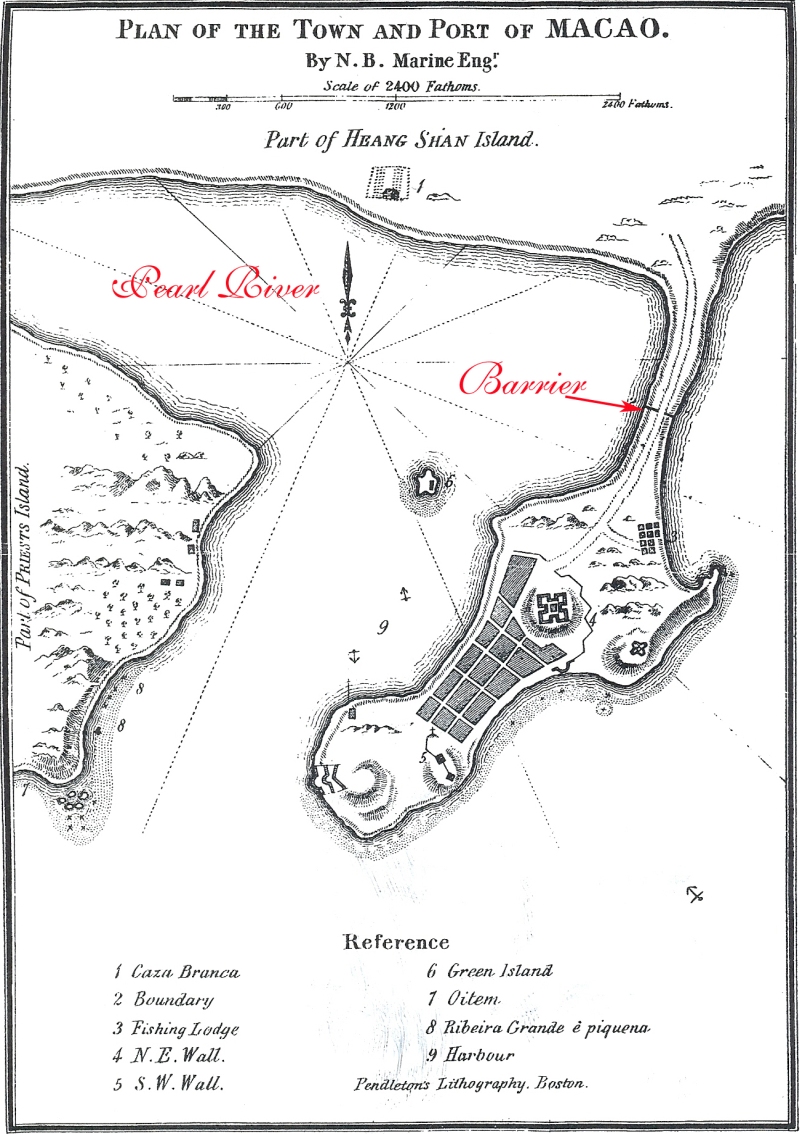
Old map of Macau
But by the middle of the 19th Century Portugal’s influence was in decline and Macau faced serious problems. China had ceded the island of Hong Kong to Britain in 1842 after the First Opium War. With its silted harbour Macau could only take shallow-drafted vessels. In contrast, Hong Kong had excellent deep and well sheltered waters and posed a serious economic threat to Macau.
Now Hong Kong thrived economically because it had been made a free port. Observing its rapid growth, the Government in Lisbon decided that Macau should follow suit. Macau’s Governor José Gregório Pegado warned that there would be serious consequences: Macau would be deprived of its major source of revenue from its Customs House; that revenue would have to be replaced by taxes which would alienate the general population and especially the alien inhabitants.

Captain João Maria Ferreira do Amaral. Governor of Macau
However, his authoritarian style, which might have been appropriate in combat, created problems with the Chinese, the British and civil leaders in Macau. He started off badly.
This was followed by a riot by Chinese over a small duty imposed on Chinese passage-boats.
“In recent years, the fields and low hills between the city and the barrier had become so popular with Chinese as a burial place that there was hardly an uncultivated acre that was not littered with tombs. In view of the city’s rising population, it was necessary to extend the town beyond the walls, and, to avoid the dangers of disease and fire, clean up the shack area under the walls. Above all, a proper road was required, connecting the city with the barrier gate to improve the absurd position whereby goods had to be borne in along small tracks through a network of smallholdings and tombs. Without fear of Chinese reactions, Amaral ordered the removal of graves as required for these works, offering compensation to poor families.
“Knowing the extreme Chinese anger this would arouse, the Senate secretly petitioned the Minister for the Colonies concerning the danger of this anti-Chinese policy. When he discovered this, Amaral disbanded the Senate, and published the full details in the government bulletin, branding the senators as unpatriotic. Amid growing Chinese discontent and the hostility of his own people, he continued his administration under what amounted to martial law.”
But Amaral was on shaky ground. He had the support of only a tiny garrison and conscripts and not a single warship. Portugal was embroiled in civil war and he could never expect military aid from that quarter. As the economic situation worsened because of the free port policy, Macau became entirely dependent on contributions from Macaense merchants, but their support was stretched to the limit, there was resentment because of conscription and morale was low.
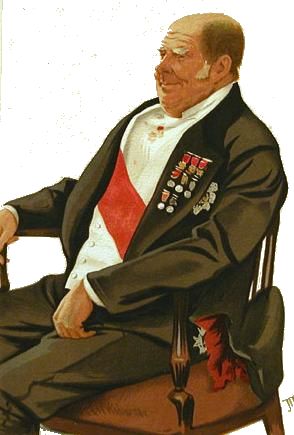
Capt the Hon. Henry Keppel
James Tissot, Public Domain, via Wikimedia Commons
The following day, three British officers, who happened to be in Macau for the regatta, called on Amaral to request Summers’ release. They were all from influential military families: Capt the Hon. Henry Keppel of HMS Meander (son of the Earl of Albemarle), army Captain Charles William Dunbar Staveley, Assistant Military Secretary in Hong Kong (son of Lieutenant-General William Staveley, the Lieutenant-Governor of Hong Kong), and Captain Edward Norwich Troubridge of HMS Amazon (son of Rear-Admiral Sir Edward Thomas Troubridge and grandson of Rear-Admiral Sir Thomas Troubridge, both of whom had fought in battles with Lord Nelson and had served as Lords of the Admiralty).
They would have seen the issue as just a religious problem.
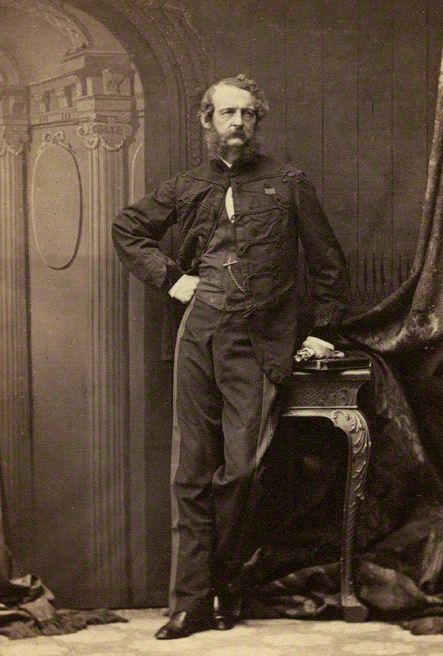
Captain Charles William Dunbar Staveley
Camille Silvy, Public Domain, via Wikimedia Commons
Amaral pointed out that, besides slighting the religion of the State, Summers had defied his bidding as Governor; but as a compromise, he offered to plead with the judge if the release were requested as a favour. Arrogantly, Keppel retorted that he wanted no favour, but demanded the release by right … and the interview ended.”13
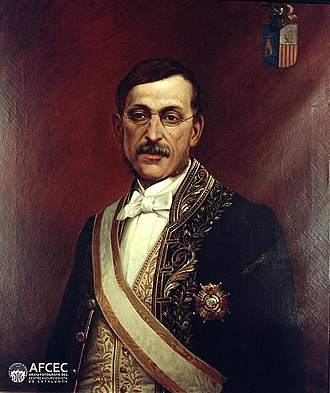
Don Sinibaldo de Mas, the Spanish minister to China
Archivo China España, CC BY-SA 4.0, via Wikimedia Commons
The next day, while Amaral sailed on a British ship for the regatta, Keppel proposed to Don Sinibaldo de Mas, the Spanish minister to China, that Amaral should be captured and detained, but was dissuaded from doing so.
Keppel instead sent a strong party of marines from his ships to Praia Grande, that landed just in front of Government House. The outnumbered Portuguese sepoy guards there awaited the order to fire, but the dumbfounded officer only looked on. The marines then proceeded to the prison next to the Leal Senado (the Senate House). A young sentry was surprised and overpowered. The marines divided into two: one group of marines entered the Leal Senado, shot dead an unarmed private and wounded three guards. The second group entered the prison, disarmed the sentry and released Summers.
“It was one of those cases which made foreigners reproach British naval commanders with arrogance and wilfulness, and look on England’s naval supremacy more like a tyranny than a friendly guardianship of the highway of nations.”
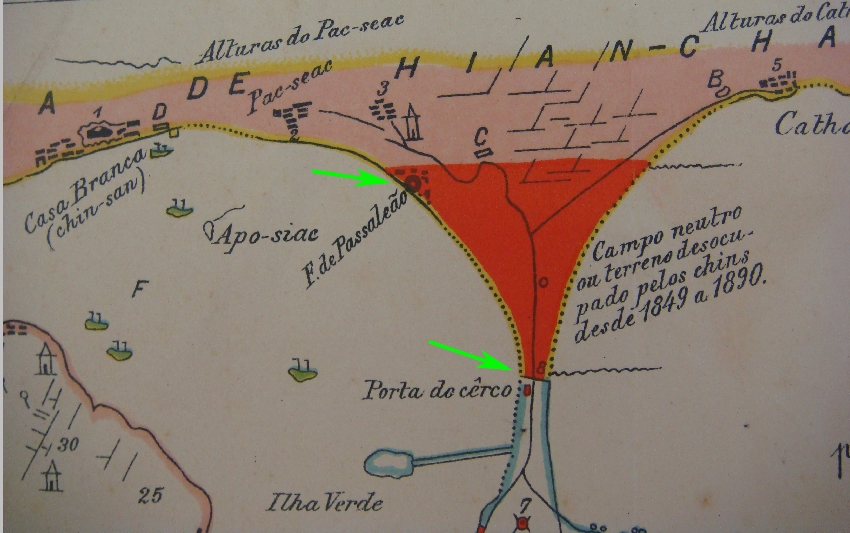
Old map of the area north of Macau with green arrows indicating Porta do Cerco and Fort Pak Shan Lan (Passaleão). The area marked in red is described as “neutral zone or terrtory unoccupied by China from 1849 to 1890”
JM Braga Collection, National Library of Australia.
There was widespread confusion and despair in the populace. In response to a distress signal (the Portuguese flag flown upside down from São Francisco Fort) a party of British marines (presumably a small detachment from Amazon and Meander) was sent in; they did not march to the front but were stationed outside Government House at Praia Grande.
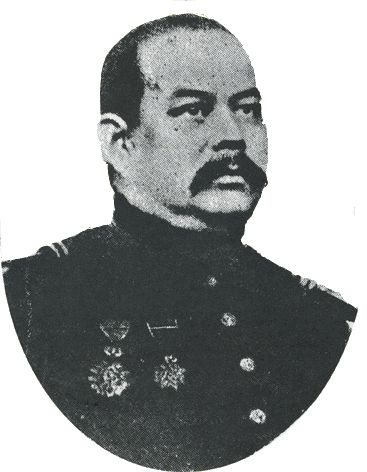
Second-Lieutenant Vicente Nicolau de Mesquita
At Porta do Cêrco the garrison’s position soon became untenable. Retreat from the barrier would have invited invasion and a sortie appeared suicidal. The foreign ministers, who attended a meeting of the Council, advised against any aggressive act. At this point, a young Macaense artillery officer, Second-Lieutenant Vicente Nicolau de Mesquita, who was serving as aide-de-camp to the Council, urged action, volunteering to lead an attack himself. The Council granted permission and gave him leave to act independently of Captain Ricardo de Melo Sampaio, the officer in command at Porta do Cêrco.
With 16 hand-picked men and a howitzer that a French naval officer had given to Amaral, Mesquita rushed to the barrier and handed Sampaio an order from the Council to move his troops forward as far as the paddy-fields beyond the barrier. Mesquita brought the howitzer to within range of Pak Shan Lan, loaded and trained the howitzer himself and fired a ingle shell that exploded over the fort. This caused a large number of deaths and demoralised the Chinese troops. But the recoil of the howitzer broke one of its wheels so that weapon played no further part in that skirmish.
Mesquita then returned to the barrier and handed Sampaio a note from the Council that gave him leave to storm the fort and called for volunteers. He moved the 20 men from the garrison and his 16 chosen men in single file towards Pak Shan Lan. The fort opened fire and Sampaio ordered a retreat to be sounded but on hearing this Mesquita ordered his own bugler to sound the advance. A shot smashed the bugle but the advance continued.
Those at the Monte Fort – including the foreign ministers – witnessed the action clearly. Mesquita’s small group negotiated its way to Pak Shan Lan through cannon fire without loss until they were under the coverage arc of the guns; at this point they came under fire from jingals (heavy muskets on supports) but these proved ineffective.
The Macanese opened fire with their rifles as they mounted the slope to the battlements. Their fire was apparently very effective but would not alone have explained the rout that followed. Quite likely, the majority of the Chinese troops were badly trained and undisciplined.
Exhausted, the attackers entered the fort just in time to stop a soldier from lighting a fuse with a flint to explode its magazine. A solitary mandarin “stretched over an embrasure” (wounded?) offered resistance but was killed and, in an act of barbarity, had his head and hand cut off and brought back to Macau on spears.
In the silence that followed the engagement, the populace in Macau feared the worst until they saw the Portuguese flag hoisted over Pak Shan Lan. When a messenger on horseback finally brought the news to Praia Grande, there was euphoria.
Before withdrawing, the attackers spiked the fort’s guns and blew up its magazine. Only one of the party was wounded. Chinese losses were unknown because they carried away both the wounded and the dead.
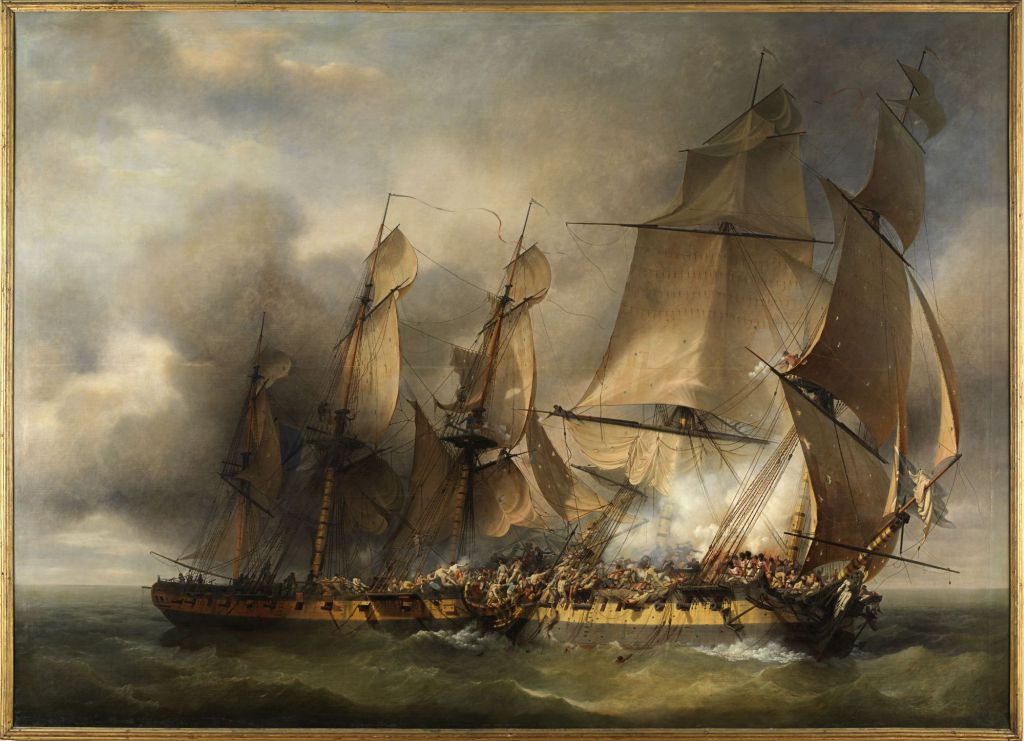
French corvette La Bayonnaise
Public Domain
The following day, the foreign powers made a point by sending British marines to the scene of the action at Pak Shan Lan. British and US warships remained at Macau and the French landed a strong detachment from the corvette La Bayonnaise (32 guns). Don Sinibaldo de Mas asked for gunboats from Manila, reinforcements were sent from Goa and Lisbon and Portuguese volunteers came from Hong Kong.
One of the assassins, Sen Chi Leong, was captured on September 12th at the village of Shon Tak. He confessed, was promptly tried and was executed three days later. On October 14th Su, the Chinese Viceroy in Canton, reported the fate of others involved in the assassination: one was wounded and captured; another wounded and drowned; a third who had turned pirate confessed that two others, also pirates, had been killed by the British in Hong Kong.
The confessions gave details of the assassination: Sen Chi Leong had approached Amaral with a petition; as Amaral stretched out his hand to receive it, Sen Chi Leong produced a sword hidden in a closed umbrella to attack his only good arm. The severed head and arm were buried near Shon Tak.
However there were other reports: that Kam Tong, their leader, had dealt the death blow, had taken the head and hand to Canton and had been rewarded there with a decoration.
Three Chinese soldiers at the barrier gate were detained by the Portuguese and held as ransom for the return of Amaral’s head and hand. After prolonged negotiations these were delivered to the Council in Macau. Amaral’s body was taken to Portugal and buried with honours in Lisbon.
Mesquita was honoured as a national hero22 but he was only rewarded slowly: by promotion to 1st Lieutenant in 1850, Major in 1863, Lt Colonel in 1867 and on retirement in 1873 to Colonel.
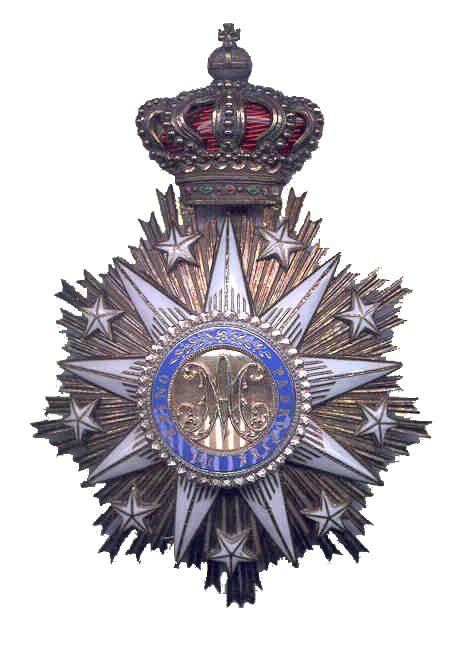
Order of Na Sra da Conceição da Vila Viços
He was appointed Knight in the Order of Na Sra da Conceição da Vila Viçosa in 1855, Knight (1857) and then Commander (1869) in the Military Order of Aviz, and received the silver military medal of valour and the silver military medal of exemplary conduct.

Military Order of Aviz
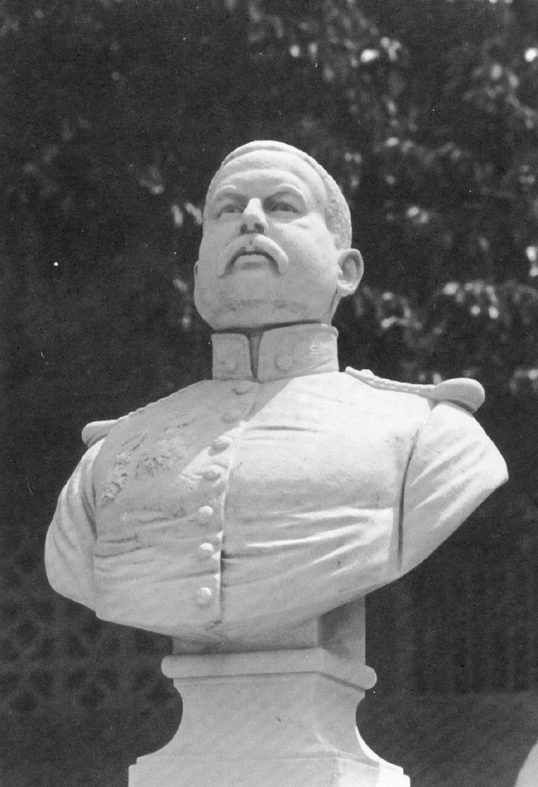
Tomb of Nicolau Mesquita
Cemitério de São Miguel
However, his fate was tragic. He suffered for many years with severe depression which affected both his private and professional life. He finally became deranged in 1880 when a daughter was seduced by a scoundrel. In a fit of madness he killed that daughter and his second wife and wounded another daughter and son and committed suicide by hurling himself down a well in his backyard.
Because of his acts of murder and suicide, the Bishop ruled that he could not be buried in hallowed ground and, on directive from the Governor, there were no military honours at his funeral. It was not until 1910 that another bishop gave permission for his body to be interred in the Cemetery of S. Miguel in Macau.
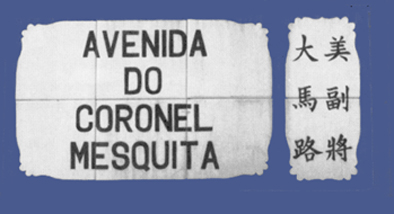
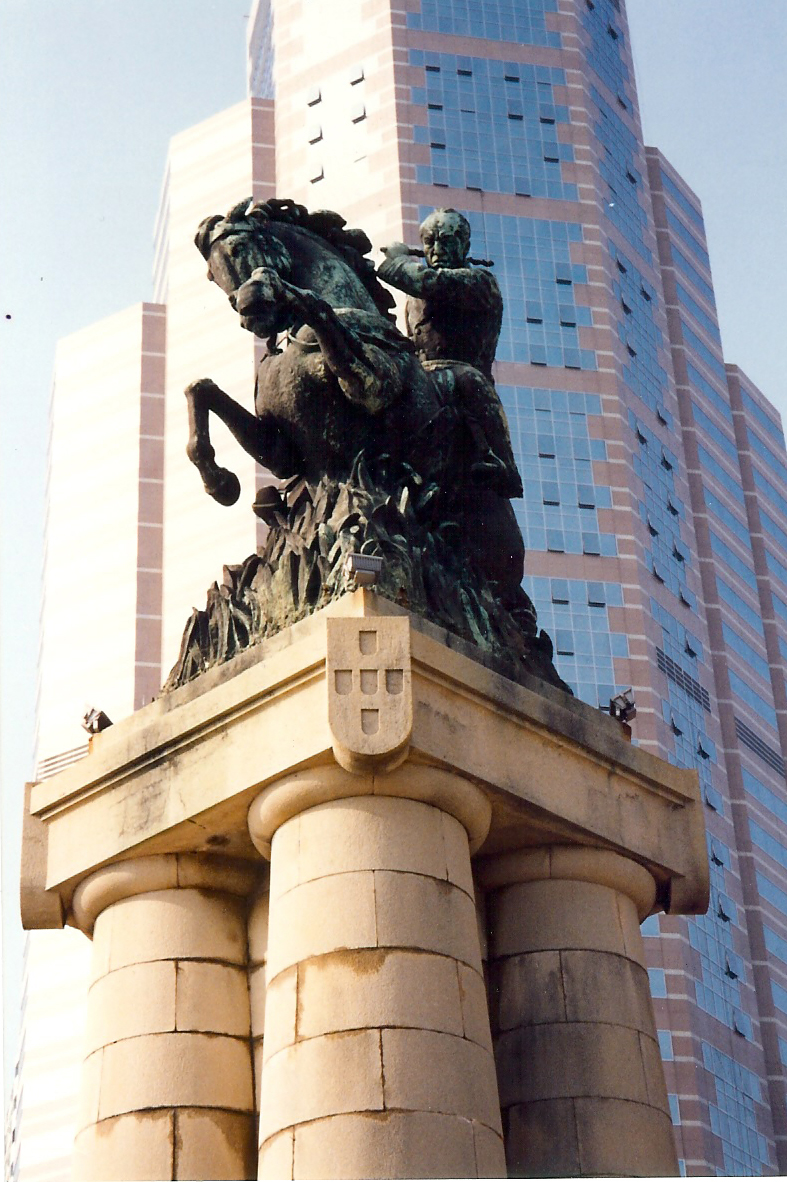
Two impressive and handsome statues, designed by Maximiliano Alves in Lisbon, were erected nearly a century later to honour Amaral and Mesquita: the former positioned near the present Hotel Lisboa and the second in front of Leal Senado. For years they added to the ambience of Macau and attracted tourists.
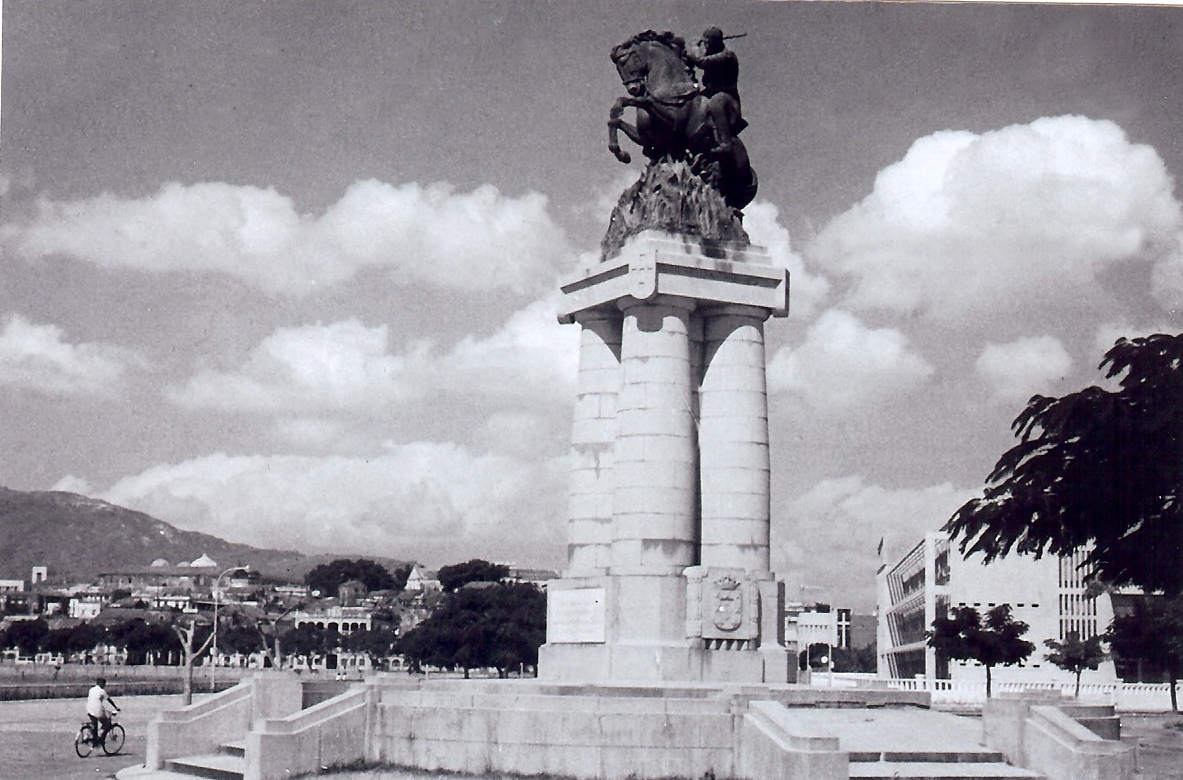
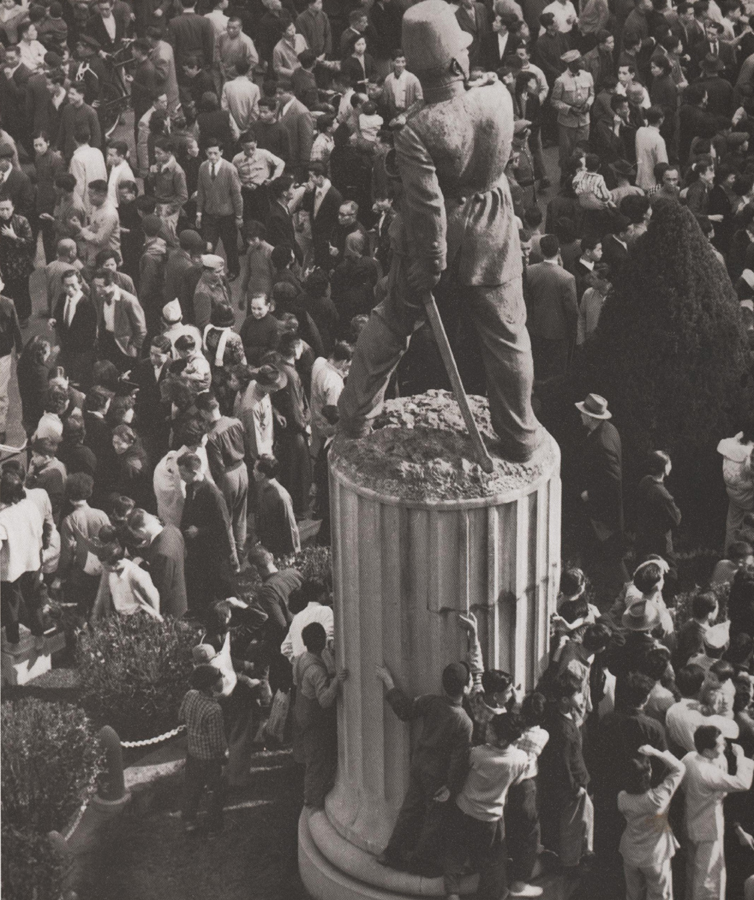
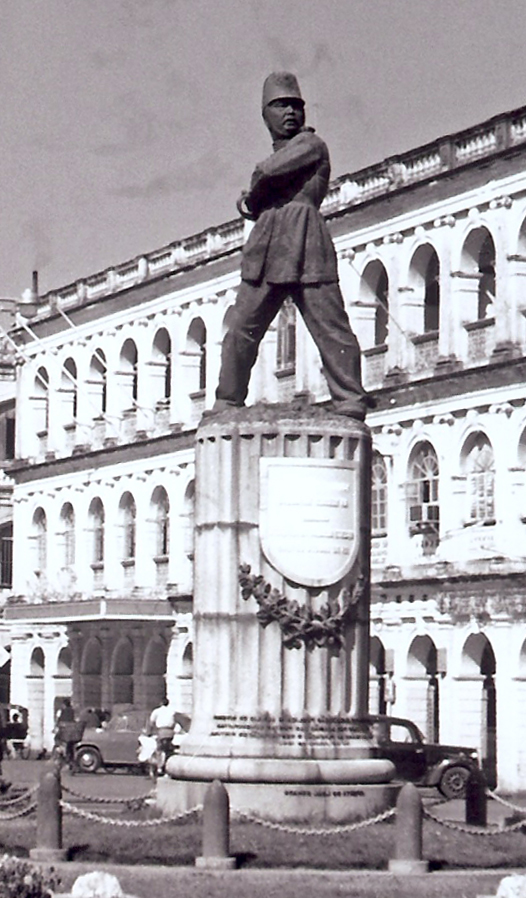
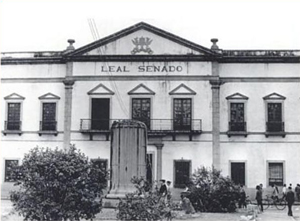
The destruction of the statue of Mesquita in 1966
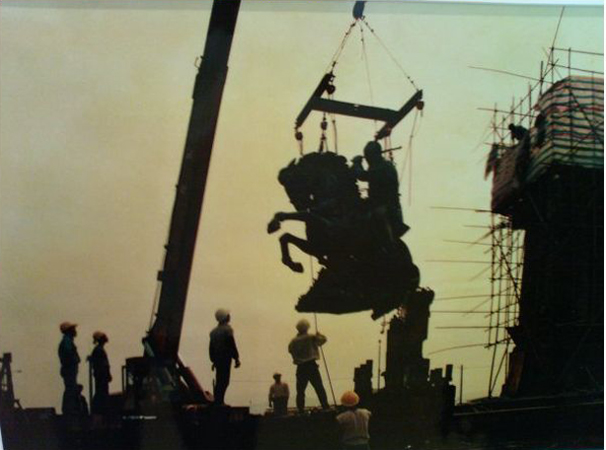
The removal of the statue of Amaral in 1993
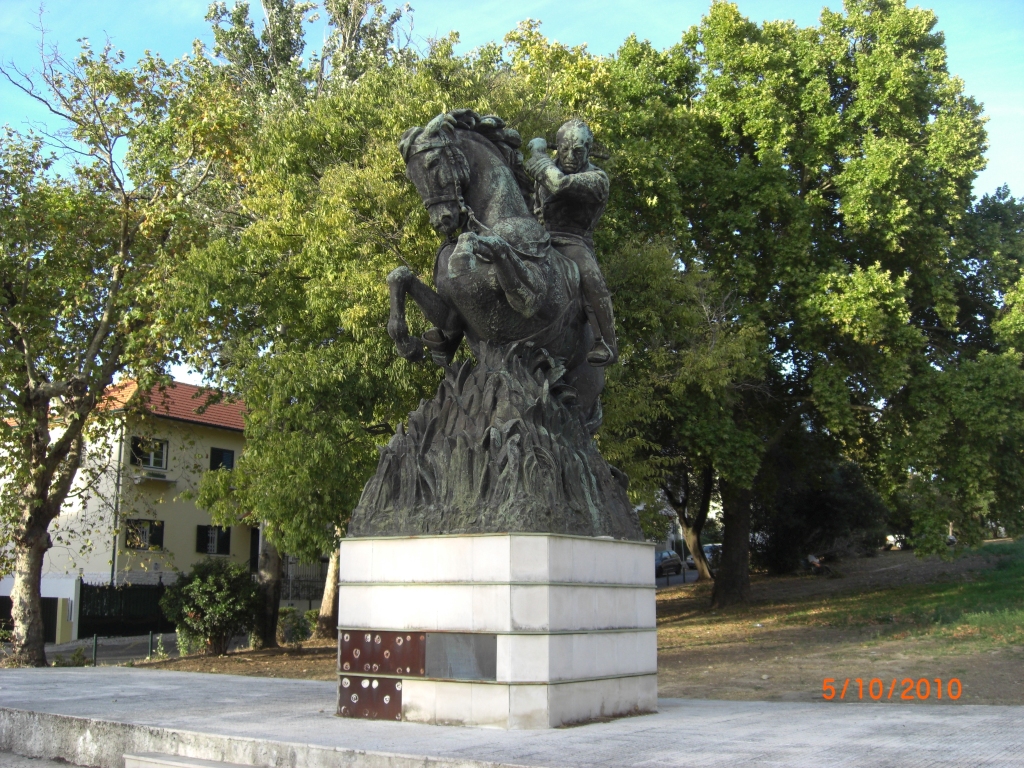
The statue of Amaral in Lisbon today
The flag of Macau