Patuá

Tenses
Tenses were generated simply with a prefix: for the past tense, ja from the Portuguese word já = already; for the present tense, ta (short for Portuguese está); and for the future tense, logo (from the Portuguese logo = “soon”, but pronounced more like the English word “logo”).
Thus from vai = go we have ta vai = going, ja vai = went or gone, and logo vai = will go.
(There is a similarity to the use of a suffix in Cantonese to denote tenses: choh, kun and wui for the past, present and future tenses respectively, but I have no idea whether the evolution of grammar in the patuá was influenced in any way by the Cantonese dialect.)
Pronunciation
In Macanese the letter “R”, at the end of most Portuguese verbs, is never pronounced (probably because of its difficulty for many Asians). Thus the verbs “abrir” (to open), “comer” (to eat) and “dormir” (to sleep) are pronounced as “abri”. “comeh” and “dormi” respectively, with the emphasis (always?) on the last syllable.
A feature of the patuá is that it is delivered in a sing-song voice but, unlike the Chinese dialects, the patuá does not rely on tonality to convey meaning. The accented syllable(s) are always delivered at a higher pitch.
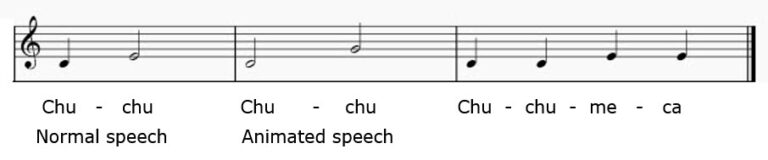
Thus chuchu (to poke or prod) is never pronouced in a flat monotone as in “choo-choo train” in English but has its second syllable delivered some 4 or 5 semitones above the first or, with heightened animation, up to 8 semitones.
Chuchumeca (busybody, stickybeak) has the first two syllables at the same lower pitch and the third and fourth at a higher pitch.
Pronúncia
Em macaense, a letra “R”, no final da maioria dos verbos portugueses, nunca é pronunciada (provavelmente devido à dificuldade que muitos asiáticos enfrentam ao pronunciá-la). Assim, os verbos “abrir”, “comer” e “dormir” são pronunciados como “abri”, “comeh” e “dormi”, respectivamente, com a ênfase (sempre?) na última sílaba.
Uma característica do patuá é que ele é pronunciado em um tom cantado, mas, diferentemente dos dialetos chineses, o patuá não depende da tonalidade para transmitir significado. A(s) sílaba(s) acentuada(s) são sempre pronunciadas em um tom mais agudo.
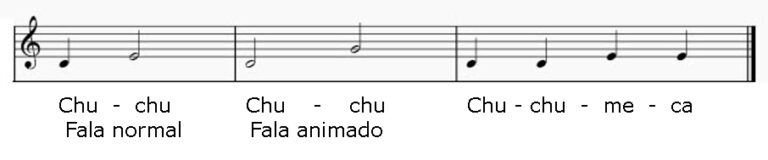
Assim, “chuchu” (cutucar ou provocar) nunca é pronunciado em um tom monótono como em “choo-choo train” em inglês, mas tem sua segunda sílaba pronunciada cerca de 4 ou 5 semitons acima da primeira ou, com maior animação, até 8 semitons.
Chuchumeca (intrometido, bisbilhoteiro) tem as duas primeiras sílabas no mesmo tom mais baixo e a terceira e a quarta em um tom mais alto.